

The product and software development landscape is changing drastically—and at an incredibly fast pace. With the exponential rise of large language models (LLMs), businesses and startups now have a powerful new tool to experiment with ideas and build prototypes within weeks of concept development. What once took years can now be transformed into MVPs (Minimum Viable Products) within months.
This shift is not just about speed—it also means reduced development costs, shorter time-to-market, and more accurate, customer-focused products. AI-driven development is fundamentally reshaping how companies bring innovation to life
At the core of this transformation are LLMs and the rise of AI-driven development methods, processes, and tools. These advancements are reshaping the entire software development life cycle (SDLC) and will have far-reaching impacts on how products are built, maintained, evolved, and even recycled.
Instead of relying solely on traditional coding, testing, and release cycles, AI brings a new layer of intelligence that:
- Accelerates development by generating code, documentation, and test cases from natural language prompts.
- Reduces errors by catching issues earlier through AI-powered debugging and automated QA.
- Optimizes maintenance by suggesting improvements, refactoring, and patching vulnerabilities in real time.
- Evolves products continuously by analyzing user behavior and recommending new features.
- Recycles and repurposes code across projects, making reuse more efficient and scalable.
These changes don’t just impact developers—they fundamentally alter how businesses adapt to customer needs, making them more agile, responsive, and competitive.
If we look at the software development process over the last two decades, it has mainly been about careful planning across SDLC process, precise development cycle , and often painstaking debugging, deployment and maintenance.
Traditional development demanded: Traditional software engineering values designing for clarity and constraints—carefully thinking through data models, selecting the right design patterns, and writing at least a minimal specification before coding begins.
- Writing code line by line with strict attention to detail.
- Long cycles of design, build, test, and release.
- High dependency on manual QA and documentation.
- Delays caused by bugs, integration challenges, and resource bottlenecks.
This approach took months or years to launch—with significant costs and risks involved.
Enter new accelerated Development with AI landscape
With new AI tools developers can now generate boilerplate code in seconds, fix bugs almost instantly, and even have AI write tests or documentation. Workflows that used to take days are now compressed into mere hours. No longer limited by typing speed or memory, a single developer armed with AI can often prototype a full-stack application in a weekend—a task that might once have required a dedicated team working for weeks.
For generations, our value as developers has been tied to our ability to think like machines—to break down problems into discrete, logical steps that computers could execute. But what happens when machines begin to understand what we want, not just what we tell them to do?
This is where programming with intent enters the picture. It represents not just another tool or technique, but a fundamental shift in how software is conceived, developed, and delivered.
In this new era, teams and leadership must rethink how the software development process implemented in companies in past and adopt new AI driven for future embracing new mindsets, tools, and processes that align with AI-augmented development. Below are some of cultural changes which I teams has to adoption in new AI driven development
1. Intent based development:
- Teams has to desired outcome based mindset rather writing step-by-step code
- Developers describe what they want, AI handles how to achieve it.
- Encourages higher-level, problem-first thinking.
2. Use AI as a Collaborative Partner
- Consider AI as pair programmer, not just a tool.
- Learn prompt engineering
- Lear to collaboration with AI and not replacement of developers.
3. lean and new Skills
- New skills: prompt engineering, AI oversight, data analysis, high-level design.
- Core mindset (problem-solving, algorithms, fundamentals) remains essential.
- Developers must adapt to new workflows without losing foundational strength
4. Evolving Developer Mindset
Perhaps most importantly, the developer community’s mindset is shifting. What started with AI handling small, repetitive tasks has grown into trust for AI assistance with larger, more complex chunks of work—including prototyping, debugging, and even system design
The AI-Assisted Engineering Approach
The rapid progress of LLMs in understanding and generating text—including programming languages—has been a game changer. Trained on vast amounts of both code and natural language, these models can now interpret intent from prompts and translate them into working software.
But there’s a catch: clarity matters. Just as vague requirements confuse human developers, vague prompts lead to incorrect or inefficient AI-generated code. This is why many are calling prompt writing the new programming literacy. The more precisely you articulate your intent, the closer the AI’s output will match your needs. On the opposite end of the spectrum from vibe coding is AI-assisted engineering—a more structured, methodical way of building software with AI as a copilot at every step. In this model, the developer remains firmly in the driver’s seat, while AI provides intelligent support across the entire software development life cycle (SDLC).
The Process Shift: Iterative AI Collaboration
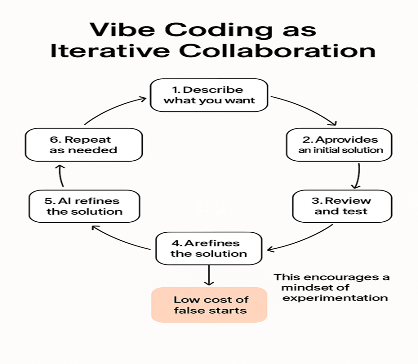
One of the most important aspects of vibe coding (intent-based programming) is that it’s not about writing a single perfect prompt and expecting flawless results. Instead, it’s an iterative, collaborative process between human and AI, resembling a rapid feedback loop.
Here’s how it typically unfolds:
- Describe what you want – You frame the problem or feature in natural language.
- AI provides an initial solution – A draft snippet or implementation is generated.
- Review and test – You check if the output works and meets your intent.
- Refine your request or code – Adjust prompts or tweak the implementation.
- AI refines the solution – It adapts based on the updated context.
- Repeat as needed – Continue until you’re satisfied.
This back-and-forth cycle encourages experimentation. A false start no longer feels costly—if the first attempt isn’t right, you quickly refine and try again this give great power for product managers to experiment and fine tune ideas, which was costlier(rework) and main reason for difference between engineering and product teams . In contrast to traditional coding, where throwing away a module could be frustrating, AI-generated iterations are cheap and fast, turning development into a more exploratory and creative process.
Who Prefers Which Approach?
These differences naturally attract different audiences:
- Vibe Coding often appeals to less-experienced developers or those outside the core engineering discipline. Product managers, designers, may lean on this style because it lowers the barrier to entry and provides quick wins. Many treat the AI like a “superpowered Stack Overflow,” giving them full solutions they can tweak and demo rapidly.
- AI-Assisted Engineering resonates more with seasoned developers and teams. Having been burned by fragile or unmaintainable code before, they approach AI with a mindset of discipline first, acceleration second. They’re willing to put in effort up front—like writing a mini-PRD or setting up tests—because they value maintainability and long-term scalability.
Think of vibe coding as a high-speed exploratory vehicle: it can take you off the beaten path quickly, making it great for discovery. AI-assisted engineering, on the other hand, is more like a reliable train on a track: you need to lay down the rails first (planning, specs, tests), but once you do, it’s a safer bet that will reach its destination without derailing.
Intermediate and advanced developers should be capable of driving both vehicles, but the choice depends on the task at hand:
- If the goal is rapid innovation or idea validation (like a hackathon or feasibility check), vibe coding provides momentum. Just remember to tighten things up if you plan to reuse that code.
- If the goal is building maintainable, production-grade features, AI-assisted engineering ensures you don’t end up with a black-box chunk of code that no one understands later
How Do Code Generation Models Work?
Code generation models are trained on massive datasets—public code repositories, documentation, forums, and Q&A sites. Through this, they learn not just the syntax of programming languages but also the semantics of how code is applied to solve real-world problems.
When you interact with an AI coding assistant, here’s what happens under the hood:
- Understanding the Prompt – The model parses your natural language request or code snippet to infer intent.
- Leveraging Context – It looks at surrounding code, comments, and even previous interactions to stay consistent.
- Generating Code – Based on patterns it has learned, the AI proposes one or more candidate solutions.
- Validating with Human Oversight – While AI generates code quickly, humans remain responsible for checking correctness, performance, and security.
What’s remarkable is that this entire loop happens in seconds or less, radically reducing iteration time in the development process.
When to Use Vibe Coding
Experiment Ideas : Rapidly go from idea to working prototype. Example: build a weekend project with AI pair programmers (something that might otherwise take a month).
System or component Integration: Writing code to connect systems, transform data, or integrate APIs. AI models are often trained on API documentation and can generate boilerplate integration code quickly.
Adopting Modern Framework : AI coding assistants are “well-read” on popular frameworks like React, Angular, Django, Rails, Node/Express, Flutter, etc. They can accelerate development by suggesting idiomatic solutions.
Repetitive work: Ideal for repetitive patterns (e.g., generating multiple endpoints, schema-based classes).
Process of Using AI in Development
- The AI model generates the initial code.
- Developers then refine, refactor, and test it.
- Developer and AI are in constant conversation
- Involves tight feedback loops, frequent code reviews, and minimal context
- Developers write the initial code.
- AI is used to validate, test, and improve it
Adoption and provision new tools companywide :
A wave of new tools is emerging to seamlessly integrate these AI models into coding workflows. From IDE plugins to cloud-based collaboration platforms, AI is being embedded directly into the places where developers work
Tools like OpenAI’s Codex, ChatGPT, Anthropic’s Claude, and others have introduced a new way of writing software. Developers can describe what they want in natural language, and the AI generates functional code.
For example, AI autocompletion tools like GitHub Copilot can suggest the next few lines of code as you type, saving keystrokes when you’re implementing known patterns. Copilot can autosuggest assertions based on a function’s name. AI can generate test cases once a feature is in place—feeding the component’s spec or code into a prompt to get suggestions for potential edge cases.
The developer is still responsible for thinking through the logic, verifying correctness, and making design decisions. The AI simply offloads the repetitive, time-consuming grunt work—freeing engineers to focus on solving higher-level problems.
Scope of the tools :
- AI-powered autocomplete & chat for faster coding.
- Automated code migrations to modern frameworks.
- Bug detection & debugging assistance to reduce errors early.
- Test generation for higher quality assurance.
- Granular code generation (functions, modules, components).
- Full project scaffolding for end-to-end builds.
Prompt Engineering Strategies, the new way of writing code :
Below are some of the well-known categories of prompt engineering. I would suggest that the skill evaluation of prompt engineering must be one of the keep items in hiring process for team members
- Example based Prompting : Simply asking the model to do with or without examples
- Chain-of-Thought (CoT) : Ask the model to think step-by-step or show reasoning before giving the final answer. Encourages logical breakdown of problems.
- Role Prompting :Ask the AI to assume a specific identity or role to influence its response. Example: “You are a Python instructor. Explain the following concept to a beginner.”
- Contextual Prompting Provide additional background or context beyond the immediate task description. Since AI does not have memory of your entire project, you must supply relevant data in the prompt.Example: Including existing code snippets so the AI can write code that fits into your project.
- Metaprompting :Give instructions about the output itself, not just the solution. Example: “Explain this in bullet points and keep sentences under 10 words.”
- Self-Consistency Strategy of generating multiple outputs for the same prompt, then selecting the most consistent or useful one. Often improves reliability compared to a single response.
- ReAct (Reason + Act) :Goes beyond reasoning: model can think + act (e.g., make a calculation, call an API, or use a tool). Often used with frameworks like LangChain, where the AI outputs a special format that triggers actions.
Guidelines for Vibe Coding
- Be specific and clear about what you want
- Clearly articulate requirements, tasks, and outcomes.
- Precise prompts yield precise results.
- Always validate AI output against your intent
- Verify functionality, logic, and relevance.
- Don’t accept code blindly.
- Treat AI as a junior developer (with supervision)
- AI output = drafts requiring oversight.
- Provide feedback, refine, and ensure correctness
LLM Models :
Below are the category of different models available in market. You can pick and choose the models based on the scope of work and indented. Or mix them to suite the goal of development.
| Speed optimised | Deep reasoning | Multimodal | Open source |
| For rapid prototyping and general coding, models optimized for speed Eg: ChatGPT | For complex debugging and system design, deep reasoning models that can trace Eg : Claude | Supports context windows that can maintain project-wide awareness Eg : Google Gemini | For budget-conscious teams, open source models provide excellent value without subscription costs |
Some of the know AI tools in market :
| VSCode + Copilot | Cline | Cursor | Windsurf |
| Integration with GitHub Copilot there’s inline code autocompletion chat interface agent mode support for the Model Context Protocol | Coding agent that can take on complex, multistep development tasks from start to finish Agentic approach MCP support browser automation | Support existing code base. Support errors and log understanding Support context and remembers the flow of code between multiple files | Good at handling large projects Support multiple files , hence context Support natural language query on code base |
Who Is AI-Assisted Engineering For?
The audience for this approach is typically professional developers and teams who already have established processes—code review, testing frameworks, deployment pipelines—that they aren’t willing to abandon.
These are intermediate to senior engineers who see AI not as a replacement for their toolbox, but as a powerful addition to it. Having experienced the consequences of cutting corners, they value practices that keep software maintainable, reliable, and scalable.
By contrast, the audience for vibe coding often includes:
- Solo developers hacking together quick demos.
- Product-minded entrepreneurs testing new ideas.
- Early-stage teams focused on speed over long-term structure.
Both approaches have their place—but they cater to very different needs and mindsets.
The Human Still Leads :In AI-assisted engineering, humans remain in control of the decisions. The AI serves as a suggestion engine and accelerator, but never as an unchecked authority. Code quality, performance, and security remain paramount. Every AI-generated snippet should face the same scrutiny as if it were written by a junior developer. A good mindset is to treat the AI like an intern, not a replacement.
You can delegate repetitive or boilerplate work to it, but you must always review, test, and understand the output before deploying. Just as you would never push unreviewed code from a human intern into production, you shouldn’t trust AI-written code without inspection.
This mindset ensures that engineering discipline stays front and center, while still reaping the benefits of AI speed.
Realistic Expectations with AI-Assisted Engineering:
If you’re practicing AI-assisted engineering, your expectations are measured and practical for long-term projects. You don’t expect the AI to do your entire job—you expect it to save time, remove friction, and occasionally spark inspiration.
The key mindset: AI is a collaborator working under your guidance. You allocate tasks where AI shines—boilerplate, repetitive code, broad-stroke implementations—while you focus on architecture, correctness, and maintainability.
Benefits of the AI-Assisted Engineering Approach
The benefits of this approach are practical and grounded:
- Improved productivity – AI accelerates repetitive tasks, giving developers more time for higher-value thinking.
- Fewer rote mistakes – An AI is less likely to misspell a variable name or forget an import, reducing small but frustrating errors.
- Broader solution search space – The AI can surface alternative patterns or algorithms you might not have considered.
.Role Changes with AI in Development: So, how does the new process, mindset , tools and scope of work change the roles in current structure ?. I have highlighted three most impact layers of team members and the aspect they need to recalibrate their scope of work
Senior Developers:
- Cultivate domain mastery and long-term foresight.
- Hone soft skills and leadership to guide teams.
Mid-Level Developers
- Manage systems integration and boundaries.
- Build deep domain expertise.
- Master performance optimization and DevOps.
- Focus on code review and quality assurance.
- Develop systems thinking.
Junior Developers
- Learn the fundamentals—don’t skip the “why.”
- Practice problem solving and debugging without AI as a safety net.
- Focus on testing and verification.
- Develop prompting and tooling skills.
- Build an eye for maintainability.
- Shift mindset: move from consuming to creating
Guidelines for Using AI in Development
- Intend based Thinking
- Be Specific and Clear
- Validate AI Output
- Treat AI as a Junior Developer
- Isolate AI Changes in Git
- Code Review for Al.
- Don’t Merge What You Don’t Understand
- Prioritise Documentation
- Share & Reuse Effective Prompts
- Reflect and Iterate
Key Benefits of AI in Development
1. Faster Development Cycles
- Projects move from concept → prototype → finished product more quickly.
- AI generates scaffolding/boilerplate code instantly.
- Developers focus on unique and high-value parts of applications.
2. Enhanced Prototyping & Experimentation
- Lower cost of trying new ideas (just describe to AI, get a draft).
- Enables rapid prototyping of multiple approaches.
- Encourages iterative ideation, leading to more creative solutions.
3. Faster resolution and debugging :
- LLMs trained on vast programming knowledge.
- Can recall obscure APIs, error fixes, or implementation patterns.
- Surfaces solutions you might not have thought of, boosting problem-solving.
4. Consistency & Standardisation
- Helps enforce coding conventions across repetitive tasks.
- Reduces variance in style/structure, making projects easier to maintain.


Leave a Reply to A WordPress Commenter Cancel reply